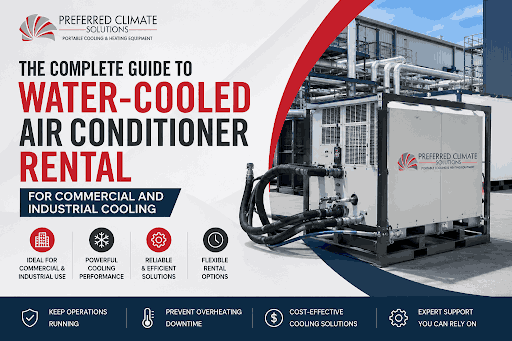
When temperatures climb, and the stakes are high, businesses cannot afford to gamble on inadequate cooling. A single afternoon of overheating can halt a production line, threaten sensitive electronics, spoil inventory, or send employees and customers heading for the exits. For facilities that need serious, reliable cooling power — sometimes on short notice — a water-cooled air conditioner rental is one of the smartest and most cost-effective solutions available.
This guide walks through everything you need to know about water-cooled cooling systems: how they work, where they shine, why renting often beats buying, and how to choose the right unit for your commercial or industrial application. Whether you are managing a data center, a manufacturing plant, a warehouse, or a large event, understanding your options will help you stay cool, productive, and protected.
What Is a Water-Cooled Air Conditioner?
A water-cooled air conditioner is a cooling system that uses water — rather than ambient air alone — as the medium for rejecting heat. In a standard air-cooled unit, a fan blows outside air across a condenser coil to dissipate the heat that the refrigerant has absorbed from inside the space. That works well enough in moderate conditions, but it becomes far less efficient when outdoor temperatures soar or when a unit is operating inside an enclosed area with little ventilation.
Water-cooled systems solve this problem by circulating water through a condenser to carry heat away. Water absorbs and transfers heat far more effectively than air, which means these systems can deliver powerful, consistent cooling even in extreme heat or in tight, poorly ventilated environments. The heated water is typically routed to a cooling tower, a drain, or a recirculating loop, depending on the setup.
The result is a machine that runs more efficiently, maintains tighter temperature control, and performs reliably in conditions where air-cooled units begin to struggle. For mission-critical applications where downtime is not an option, that reliability is invaluable.
Water-Cooled vs. Air-Cooled: Understanding the Difference
Choosing between water-cooled and air-cooled cooling comes down to your environment and your performance demands.
Air-cooled units are simpler to deploy because they only need access to outside air and electrical power. They are a great fit for many general-purpose applications. However, their efficiency drops as the surrounding air heats up, and they release warm exhaust air that must be vented somewhere — a real limitation in enclosed spaces.
Water-cooled units, by contrast, maintain their efficiency even when the mercury rises. Because they reject heat into water rather than into already-hot surrounding air, they keep cooling capacity steady on the hottest days of the year. They also tend to operate more quietly and can be placed in locations where venting hot air would be impractical. The trade-off is that they require a water source and a way to handle the heated water, which adds a layer of planning to the installation.
For commercial and industrial settings that demand high capacity and consistent performance, water-cooled technology frequently comes out ahead — especially during peak summer loads or in process-cooling applications where precise, dependable temperatures are essential.
Why Rent Instead of Buy?
Purchasing a high-capacity commercial cooling system is a major capital investment, and for many businesses, it simply does not make financial sense. This is where a flexibleAC Rental program becomes a game-changer. Renting offers a host of advantages that ownership cannot easily match.
Cost flexibility. Renting converts a large up-front purchase into a predictable operating expense. You pay only for the cooling you need, when you need it, without tying up capital or taking on long-term maintenance obligations.
Scalability. Cooling needs are rarely constant. A manufacturer might need extra capacity during a summer heat wave, an event company needs cooling only for the duration of a show, and a facility undergoing renovation might need temporary cooling for a few months. Renting lets you scale up or down to match real demand.
Emergency readiness. When a permanent system fails unexpectedly, a rapid rental deployment can keep operations running and prevent costly losses. Reputable rental providers can often deliver and install equipment quickly, minimizing downtime.
No maintenance burden. Rental agreements typically include service and support, so you are not responsible for repairs, parts, or the long-term upkeep that comes with owning industrial equipment.
Access to the right equipment. Rather than being locked into one owned unit, you can choose the exact size and type of system that fits each job. As your needs change, so can your equipment.
For seasonal demands, special projects, emergencies, and supplemental cooling, renting almost always delivers more value and less risk than buying.
Common Applications for Water-Cooled Rental Units
Water-cooled rental systems serve an impressively wide range of industries and scenarios. Here are some of the most common.
Data centers and server rooms. Electronics generate enormous amounts of heat, and even brief overheating can damage expensive hardware or trigger shutdowns. Water-cooled units provide the precise, reliable temperature control these environments demand.
Manufacturing and industrial process cooling. Many production processes require tightly controlled temperatures, whether for equipment, materials, or worker safety. Water-cooled systems keep operations running smoothly even in hot, enclosed plant environments.
Warehouses and distribution centers. Large open spaces with limited ventilation are difficult to cool efficiently. High-capacity water-cooled units can maintain comfortable, safe conditions for both staff and stored goods.
Events and temporary venues. Conferences, festivals, weddings, and trade shows often take place in tents or spaces without adequate permanent cooling. A temporary cooling rental keeps guests comfortable regardless of the venue.
Healthcare and laboratory facilities. Hospitals, clinics, and labs frequently have strict temperature requirements for equipment, medications, and patient comfort. Reliable supplemental cooling is critical when primary systems need backup.
Emergency and disaster recovery. When a building’s HVAC system fails during peak heat, a fast rental deployment can be the difference between business as usual and a costly shutdown.
In each of these cases, the combination of high capacity, dependable performance, and flexible deployment makes rental units an ideal fit.
The Versatility of a Water Cooled Portable Air Conditioner
Not every cooling challenge calls for a large, permanently installed system. Sometimes you need powerful cooling that can be moved exactly where it is needed — and that is where a water-cooled portable air conditioner proves its worth.
Portable water-cooled units combine the efficiency benefits of water cooling with the convenience of mobility. They can be rolled into position to cool a specific zone, a piece of equipment, or a temporary work area, then relocated as needs change. This spot-cooling capability is especially useful in facilities where only part of the space needs additional cooling, or where cooling demands shift from day to day.
Because these units reject heat through water rather than relying solely on venting hot air, they handle high-heat and enclosed environments better than many standard portable units. For factories with hot zones around machinery, server closets that run warm, or temporary workspaces during a project, a portable water-cooled solution offers targeted relief without the cost or commitment of a permanent installation.
The portability also simplifies logistics. Units can be delivered, positioned, and put to work quickly, and they can be redeployed throughout a facility as priorities change over the course of a project or season.
Key Benefits of Water-Cooled Cooling Rentals
Bringing the advantages together, here is why so many facility managers turn to water-cooled rental systems:
Superior performance in extreme heat. While air-cooled units lose capacity as temperatures rise, water-cooled systems maintain steady output, making them dependable during the hottest, most demanding conditions.
Energy efficiency. By transferring heat to water more effectively than air-cooled systems transfer it to hot outdoor air, these units often consume less energy to deliver the same cooling, which can translate into meaningful savings over the rental period.
Compact footprint and quiet operation. Water-cooled units can often deliver more cooling capacity per square foot and tend to run more quietly, which is valuable in space-constrained or noise-sensitive environments.
Reliability for critical operations. For applications where downtime is unacceptable, the consistency of water-cooled cooling provides peace of mind and protects against costly interruptions.
Flexible deployment. Rental units can be scaled, relocated, and removed to match your real-world needs rather than forcing you to plan around fixed, owned equipment.
How to Choose the Right Unit
Selecting the right water-cooled rental system involves matching the equipment to your specific situation. A few key considerations will guide the decision.
Cooling capacity. Cooling output is measured in BTUs or tons. The right capacity depends on the size of the space, the heat load from equipment and people, insulation, and how hot the environment gets. Undersizing leads to poor performance, while oversizing wastes energy and money. An experienced rental provider can help you calculate the correct capacity.
Water source and disposal. Because these units rely on water to reject heat, you will need to confirm access to an adequate water supply and a method for handling the heated water — whether that is a drain, a recirculating loop, or a cooling tower. Planning this early prevents installation surprises.
Power requirements. High-capacity units may require specific electrical service. Verify that your facility can supply the necessary voltage and amperage, or plan for the appropriate power arrangements.
Space and placement. Consider where the unit will sit, how air will be distributed to the target area, and whether a portable unit or a larger stationary system best fits the layout.
Duration and seasonality. A short-term event has very different needs from a multi-month supplemental cooling project or year-round backup. Match the rental term and equipment to the timeline.
Backup and support. For critical applications, ask about response times, on-call support, and whether backup equipment is available in case of an issue.
Working with a knowledgeable provider takes the guesswork out of these decisions. The right partner will assess your needs, recommend appropriate equipment, and handle the technical details so you can focus on running your operation.
You can also read about the Emerging Digital Tools Are Revolutionizing Tribal.
Installation and Logistics
One of the underrated advantages of renting is that the heavy lifting — literally and figuratively — is handled for you. A quality rental provider manages delivery, placement, connection to power and water, and commissioning of the system. They will also coordinate removal at the end of the rental term.
For temporary and emergency situations, speed matters. The best providers maintain ready inventory and experienced technicians who can mobilize quickly, often deploying equipment within hours of a call in urgent cases. This responsiveness is exactly what makes rental such a powerful tool for business continuity.
Throughout the rental period, ongoing support keeps the system running smoothly. Regular monitoring, prompt service if issues arise, and clear communication ensure that your cooling never becomes a worry.
Beyond Air Conditioning: When to Consider a Cooler Rental
Cooling needs vary, and air conditioning is not always the only answer. In some settings — large open industrial spaces, outdoor work areas, loading docks, or partially enclosed environments — an evaporative Cooler Rental can be a practical and economical alternative. Evaporative coolers use the natural cooling effect of evaporating water to lower temperatures, and they perform well in dry climates and well-ventilated spaces where traditional air conditioning would be inefficient or impractical.
Understanding the full range of options — from water-cooled air conditioners to portable units to evaporative coolers — allows you to choose the most effective solution for each unique challenge. A versatile rental provider can offer guidance across all of these technologies, helping you match the right tool to the right job rather than forcing one approach onto every situation.
Conclusion: Reliable Cooling When and Where You Need It
For commercial and industrial facilities, cooling is not a luxury — it is a critical component of safe, productive, and profitable operations. Water-cooled air conditioning delivers the high capacity, efficiency, and reliability that demanding environments require, and renting makes that performance accessible without the expense and commitment of ownership.
Whether you are protecting sensitive equipment, maintaining a comfortable workplace, keeping a production line running through a heat wave, or responding to an unexpected system failure, a water-cooled air conditioner rental gives you the flexibility to meet the moment. From compact portable units that cool a single hot zone to large systems that handle an entire facility, the right rental solution keeps you in control of your environment.
If you are weighing your options, start by assessing your space, your heat load, and your timeline — then partner with an experienced provider who can match you with the ideal equipment and handle the logistics from delivery to removal. Explore a complete AC Rental program to find the cooling power your operation needs, exactly when and where you need it.