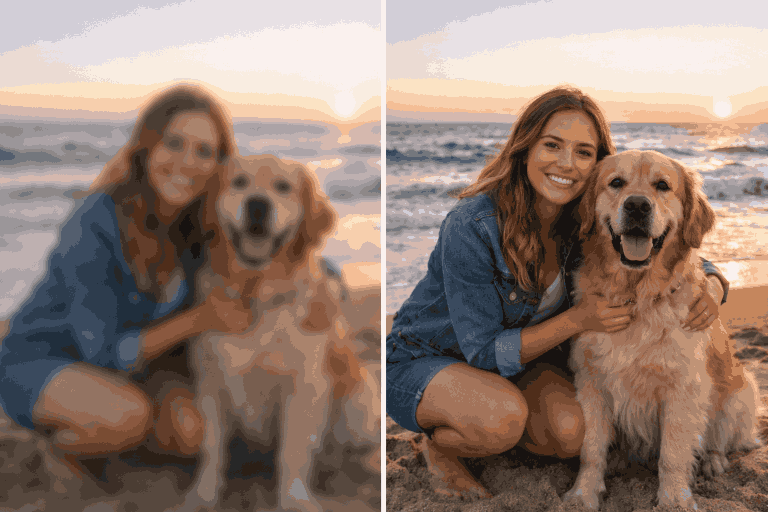
The Rise of AI Image Upscaling Technology
In today’s visually driven world, the expectation for sharp, impactful imagery is at an all-time high. Professionals and hobbyists alike often face the challenge of working with low-resolution photos that fail to command attention or convey details effectively. New solutions, such as image upscaler technologies, have emerged to change the way we approach image enhancement, offering hope for everything from cherished family photos to dynamic business assets.
AI image upscalers rely on advanced deep learning models to convert grainy or pixelated images into crisp, clear visuals that rival high-definition originals. This breakthrough means that a single click can now reveal hidden textures, restore lost edges, and provide visuals suitable for both digital and print media.
What sets these AI-driven tools apart from traditional resizing techniques is their ability to learn from enormous datasets. This allows them to anticipate what “should” be present in a photo, intelligently filling in the visual gaps and rendering missing details, a quantum leap over the simple stretching algorithms of the past.
The significance of AI upscaling is rapidly growing. As organizations and individuals demand higher-quality digital content, these tools are poised to redefine standards across a range of creative and commercial landscapes.
Understanding AI Image Upscalers
At the heart of every effective AI image upscaler is a complex neural network trained to recognize millions of visual patterns. These deep learning algorithms analyze features such as color gradients, contours, and objects within the photo. By referencing their training, the algorithms reconstruct and predict finer details, enhancing resolution without introducing jarring artifacts or blur.
Traditional upscaling tools have relied primarily on interpolation, filling gaps with averaged pixel values, which can strip away essential sharpness and yield unnatural visuals. AI upscalers, conversely, amplify an image’s authenticity by learning from real-world image data, as demonstrated by researchers and industry leaders who have embraced machine learning for visual content. For further reading, this CNET article explains how AI is bridging the gap for low-res images.
You can also read about the Top 5 OST to PST Converter Software.
Applications Across Industries
The adaptability of AI image upscalers has opened new possibilities in several fields:
- Photography: Photographers can now recover old, precious images that were thought lost due to poor quality or time degradation. AI allows for seamless restoration and large-format printing without visible pixelation.
- E-commerce: Online sellers thrive on first impressions. High-resolution product images enhanced by AI create compelling presentations, reduce buyer hesitation, and increase trust.
- Digital Art: Artists benefit by scaling up intricate digital pieces for exhibitions, posters, or merchandise, preserving detailed brushstrokes and shading with accuracy.
- Media and Entertainment: Video editors and publishers can remaster vintage content, delivering HD experiences for a modern audience. Streaming platforms have begun to leverage upscaling to upgrade older content libraries.
Leading AI Upscaling Tools
As demand surges, several tools have come to symbolize the gold standard in AI upscaling:
- Topaz Labs’ Bloom: Known for its user-friendly web interface, Bloom is tailored to enhance AI-generated images and CG artwork. With up to 8x magnification and five distinct enhancement levels, it caters to both subtle touch-ups and dramatic transformations.
- Leonardo’s Universal Upscaler: This tool offers a unique solution for repairing and preserving the quality of both photographs and illustrations. It’s especially helpful for restoring family albums or enhancing portfolio artwork.
Integration into Mainstream Platforms
The integration of AI upscaling is not limited to niche tools. Major tech platforms are embedding this functionality into widely used applications, helping users make the most of their digital assets. For example, Adobe has recently updated Photoshop with AI-powered features that can smartly upscale images up to 8 megapixels, making professional enhancement more accessible than ever before. This advancement is particularly useful for photographers and designers aiming to repurpose content across various formats. You can read more about Adobe’s innovations in this TechCrunch article.
Challenges and Considerations
AI upscaling, while innovative, comes with its own set of challenges. The outcome often depends heavily on the original photo’s resolution and quality. AI cannot reproduce details that did not exist to begin with, and occasionally, heavy-handed enhancement can introduce distortions or “hallucinated” textures, leading to unnatural results. Responsible usage and understanding AI’s capabilities remain key to maximizing quality while maintaining authenticity.
The Future of Visual Content Enhancement
The pace of AI advancement suggests the future holds even more sophisticated solutions for image upscaling. With continued investment in research and a focus on realism, platforms will soon offer real-time enhancement capabilities for both still images and video streams. These innovations promise to make professional-grade visuals accessible to a wider global audience, further bridging the gap between low and high-resolution content.
AI image upscalers are redefining the possibilities of digital creativity and restoration. By upgrading low-res visuals into high-quality masterpieces, these tools are empowering a new generation to present, preserve, and share experiences with clarity and impact.