The world of modern plumbing projects is constantly changing with the emergence of new technologies, materials, and methods that are implemented throughout the industry. The best practice will result in more efficiency, sustainability and overall better outcomes of all the stakeholders. Reliable supply networks like Cruco Mill & Industrial Supply North Carolina will assist professional plumbers to obtain state of art goods that ensure that their projects are ahead of the times.
It is an advantage to residential and commercial property that plumbing contractors are flexible and progressive. By remaining aware, not only would time, money, and damage be reduced, but clients would be able to install the plumbing that will be more enduring and efficient in terms of resources. In this article, you will find some practical recommendations that can assist your next plumbing project to open a new level of performance and quality.
Implementation of Smart Plumbing Technologies.
The smart plumbing systems have transformed the water management paradigm. Having gadgets like Wi-Fi-enabled shut-off valves and water leak sensors, homeowners and managers of the facility can get real-time notifications of abnormal water consumption, leakage, or other problems. Immediate communication means that response time will be reduced, which may prevent structural damages, mold, and losses of large quantities of water. Smart homes specifically depend on these technologies to bring the plumbing systems into the broader energy management and automation initiatives. By adopting and servicing such products, contractors remain relevant in a marketplace that is getting more connected thereby providing convenience and peace of mind to their customers.
Implementation of Sustainable Materials and Practices.
Progressive plumbing is concerned with the environment. The eco-friendly fixtures, including low flow toilets, water saving faucets, do not reduce functionality. Advanced systems may have greywater systems which divert used and reusable water (used shower and sink) and use it to flush toilets or water landscaping. Such systems conserve fresh water requirements and may reduce utility expenses in the long run. Incorporating sustainable solutions in a project not only addresses the demands of the growing and rising needs of clients to have a green living but also the government regulations and certification programs, including LEED. To learn more about creating a plumbing that is sustainable, visit this extensive guide of the EPA WaterSense Program.
Application of Advanced methods of installation.
Modern plumbing projects have the aim of increasing the installation speed and reliability. New piping systems such as PEX tube and manifold systems are being used more and more in comparison to the traditional one because they can be flexible and therefore are easy to install besides it being lighter. A proper design and layout with straight pipeflow and a reduced number of fittings increases flow rates and reduces chances of leaks or pressure losses. These new practices will enable the crews to finish work in less time, save labor and materials, and finalize an end product with fewer long-term problems.
Adopting the Modular Plumbing Systems.
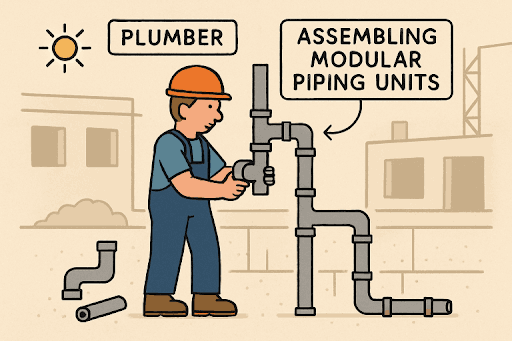
Modular plumbing systems offer the requirement of efficient and scalable construction. Prefabrication of complete piping systems or bathroom units in controlled conditions reduces construction project schedules and eliminates the activities that upset the construction site, thereby reducing the disturbance. A modular approach will result in uniform quality, reduced on-site wastes, and reduced project delivery times. Since the prefabricated construction or the modular buildings are in increasing demand, plumbing contractors have the opportunity to stand out by learning to master such simplified assembly techniques.
Investment in Sophisticated Tools and Equipment.
To be competitive, it is necessary to upgrade the plumbing tools and machines to modern ones. Pipe-cutting and threading machines, trenchless pipe installation machinery, and video pipe inspection equipment all assist in making the work faster, safer and more precise. Such innovations save labor, make the work of workers less physical, and also provide installations with high and high-quality criteria. The adoption of high-quality tools is also a good investment towards safety in the job site and improved business efficiency in the long term.
You can also read about Preventing Common Chimney Problems.
Making Collaboration and Communication a Priority.
Open and effective communication is used to make sure that all areas of the project are in line with established objectives. During planning and implementation, plumbers have to remain in touch with the project managers, architects, and other trades. The regular updates and structured meetings assist in resolving design conflict at a reduced rate, expedite in solving issues and ensure timelines are maintained. Collaboration Professionalism forms enduring business relationships and produces superior outcomes to the clients.
Adopting the Lean Construction Principles.
Lean construction focuses on value creation and reduction of wastes. The methods of supply of materials just-in-time, continuous improvement of working processes, and value stream mapping help to detect those inefficiencies and eliminate unnecessary stages of the process. Implementing the lean principles will contribute to the maximization of the effect of the labor, decrease the volume of the unspent inventory, and enhance the satisfaction of clients. The plumbing contractors who are leaders in lean approach achieve competitive advantage through constant speed and quality work.
Application of Building Information Modeling (BIM).
The BIM technology makes the plumbing systems design and implementation easier as it enables the virtual modeling and planning of the system prior to the commencement of the construction. The 3D models are detailed and they are used to determine the layout conflicts with the electrical and HVAC or structural systems. BIM also enables clear and precise coordination of all trades resulting in less changes on site and better workflow. This online method has become a best practice of large-scale construction and makes plumbing professionals significant contributors of multidisciplinary construction. In this article by ConstructConnect, read further on the advantages of BIM in terms of construction coordination.
With the integration of the most recent smart technologies, sustainable practices, and digital tools of modeling, the plumbing professionals will be able to see to it that every project is future-proof, resource-saving, and responsive to the evolving needs of the industry.