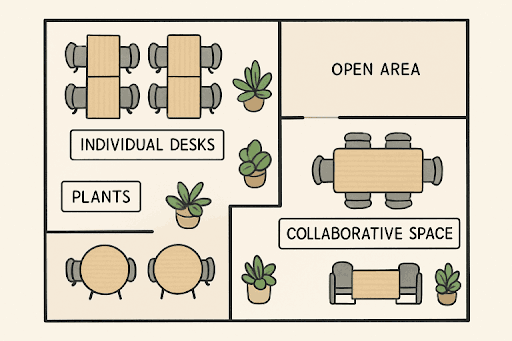
Contemporary office settings are changing very fast to adapt to the emerging work fashion, emerging technology and increased demands by employees. Space planning and design of a work place is no longer about the beauty of it. Instead, strategic planning plays a critical role towards promoting productivity, teamwork, and health. Workscape Designs a commercial interior design agency, is one of the places where the intentionality in each square foot of the office design is highlighted, so that space looks pleasing, as well as is effective to those who use it.
Intentional space planning refers to a process that involves planning and designing of office space to facilitate operations of the firm and teams developing needs. Companies that focus on this strategy create a base to a more productive, flexible and inspired workforce.
Realizing Intended Space Planning.
It is not merely the arrangement of the furniture in the room, or the choice of elegant accessories. It is an orderly process maximizing use of workspace, which provides its maximum functionality and comfort. The firms evaluate patterns of workflow processes, communication, and technology requirements to develop dynamic environments, which depict their brand culture and operational objectives. Good plans cater to both the needs of the masses and individuals with consideration given to good management, flow of movements and accessibility to all the employees.
It is one of the key elements of an intentional space planning that would have an eye directed towards the future and its growth. An organization needs a carefully considered office design that will be able to support the growing workforce, introduction of new technologies, and even changes in the business models. This involves a flexible infrastructure (flexible walls, flexible furniture, tech-integrated installations, etc.) that can be reconfigured without much trouble when the company transforms. Firms that build future-readiness in their strategies have the long term advantage of not only being cost effective but also remaining competitive in the fast changing market environment.
Improving Teamwork by Design.
Team working is the blood of most thriving firms and office designing contributes largely to the creation of this synergy. Open-plan offices, e.g. are structured in a way that promotes accidental interactions and provokes spontaneous brainstorming. But it is also the case that these layouts may contribute to noise and distractions. In order to overcome this, most organizations are adding flexible surroundings, including portable walls and teamwork and concentrate areas.
Along with physical setup, it is essential to carefully incorporate digital tools of collaboration. The use of digital whiteboards, interactive displays and strong connectivity infrastructure facilitates the exchange of ideas and collaboration by the teams regardless of their location which could be in the same room or in different continents. Such technology when included in intentional space planning eradicates the obstacles to proper communication and improves the creative process.
In addition, deliberate team work areas go beyond mere meeting rooms. The inclusion of break-out areas, the informal lounges, and external workspace will offer employees different environments to conduct team-based activities. This diversity helps to sustain a combination of scheduled meetings, an ad-hoc discussion and inventive sprints, all of which foster business innovation.
The change to Hybrid Work Models.
The revolution of the hybrid workplace has also led to organizations reconsidering their spatial approach, merging face-to-face work with remote work. The offices are now concerned with designing modular office stations, technology incorporated meeting rooms that enable the communication between employees in the office and those who are working remotely. The flexible design such as the use of touchdown space and bookable rooms enables teams to select the appropriate environment in which each task will be conducted and develop a culture of inclusivity and trust.
The resource allocation also has to be thought over in hybrid configurations. Creating special zones that can be used either in quiet mode known as focus pods or in group collaboration and wellness rooms can be used to ensure a smooth transition of employees towards various work conditions. The effectiveness of hybrid models is based on the effective guidelines of using the space and introduction of the scheduling systems avoiding overcrowding and serving organizational purposes. The usage data is analyzed by companies continuously changing the space plan to accommodate the changing team dynamics and business priorities.
Notably, the needs of remote employees and hybrid employees are also taken into account when planning an intentional office, where the workspace is the main center of culture and training as well as connection. As an example, hybrid-ready offices can have high-quality video conferencing suites, collective digital project boards, and flexible furniture that helps to transition to solo and group work in a short period.
You can also read about Smooth Transition After Selling Your Home.
Focusing on Employee Well-being.
Companies have acknowledged the irrefutable role of the carefully-crafted interiors towards health, mood, as well as retention. Natural lighting, biophilic features, ergonomic furniture, and on-site facilities are some of the features that have been introduced in office interiors to make them comfortable and uplift morale. According to the Harvard T.H. Chan School of Public Health, the offices that included natural materials and flexible lighting experienced an increase in employee satisfaction and productivity. An example is the Harvard Healthier Building Academy which deals with design and operation of healthier buildings by improving the quality of indoor air, providing more daylight, and utilizing natural materials.
Finding ways to take care of the employee’s well-being also involves the establishment of stress-reducing environments. Having quiet areas and meditation rooms as well as access to green areas within or close to the office, contributes to employees refilling their energy without having to go out of the office. Physical health can be encouraged through use of sit-stand desks, walking paths and inviting stairways, whereas a sense of belonging can be achieved through social interaction areas.
In addition to the traditional workspace, purposeful design may take into account holistic health with on-site cafes, wellness areas or gymnasiums. Every design decision must imply the familiarity with the needs and preferences of the employees, which will translate into better engagement, decreased absenteeism, and increased organizational loyalty.
Space Optimization based on Data.
Data analytics will help companies to make more intelligent decisions regarding their office environments. Monitoring occupancy, movement, and employee preferences allows organizations to perfect layouts to prevent congestion, minimise unused space, and invest in areas that are highly appreciated by employees. This information-based strategy enables offices to develop with the emergence of new requirements and maintain the alignment with the business goals and workforce trends.
Technology (through sensor- based occupancy analytics and space-booking solutions) offers real-time occupancy information about space use. This can be optimized continuously either through replacement of resources, redesigning workstations or development of new facilities. What comes out is a “learning office which is constantly refined by the occupants.
Final Thoughts
The success of the modern office can be seen in the fact that it is able to change and accommodate the individuals who use it daily. It is based on intentional space planning to provide the foundation of this flexibility so that workspaces are in tandem with business objectives as well as with the aspirations of the employees. Companies planning well and investing in participatory, adaptable, and well-being cultures develop a culture that is prepared to handle the demands in the future.
Ultimately, intentional space planning is an investment in people. By deliberately shaping the places where work happens, organizations empower employees to do their best work, inspiring creativity, supporting diverse needs, and building community. As work continues to change, those companies that put intentionality at the heart of their design will be best positioned for sustained success, innovation, and growth.