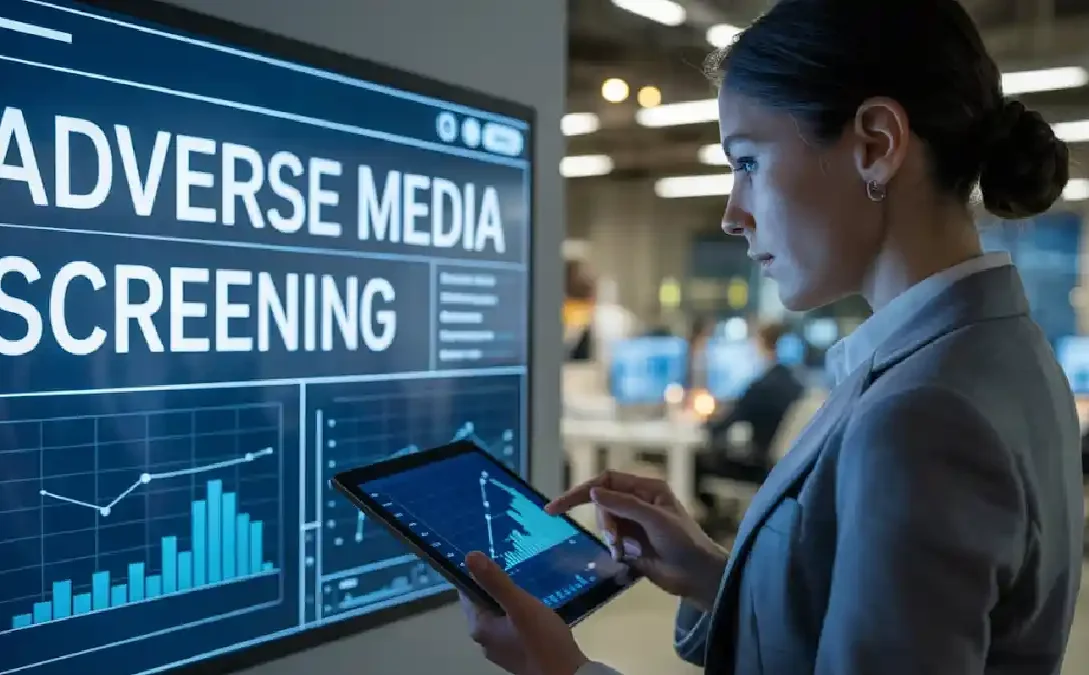
Media screening has emerged as one of the most important elements of today’s risk management and compliance in the United States. Be it a financial institution screening a new client, a corporation screening a would-be business partner, or a law firm doing due diligence, the knowledge of the reputation of the individual or organization in the news cycle can be the difference between a good move and an expensive one. With an increase in regulatory pressure and more sophisticated financial crime, organizations are finding it increasingly impossible to afford not to go through this crucial step.
What Does Adverse Media Screening Mean?
In its most basic form, adverse media screening can be defined as a search of publicly available information such as news articles, regulatory filings, court records and online publications, to conduct a search of a negative or potentially harmful information about an individual or an organization. It is part of the Know Your Customer (KYC) and Anti-Money laundering (AML) compliance models.
In a report by the Association of Certified Anti-Money Laundering Specialists (ACAMS) (2023), an over 70 percent of U.S. based compliance professionals have cited negative news monitoring as one of the highest priorities in their risk assessment process. This is a developing industry consensus: database checks cannot be done traditionally. Unfavorable media scans give a background which structured databases cannot have.
Forms of Adverse Information Organizations Seek.
Negative media inspections generally have a large scope of risks. Some of the common screening checks in compliance teams include those related to participation in financial crime, fraud, money laundering, bribery or tax evasion. They also seek associations with sanctions, financing terrorism, organized crime, and human trafficking. Environmental breaches, cybersecurity breaches and reputational scandals are also growing more and more in the mix – especially in those sectors that fall under ESG (Environmental, Social, and Governance) examination.
The practice of Negative News Monitoring.
Negative news monitoring cannot be implemented as a one-time affair, but rather it is a continuous responsibility. In the case of the U.S. financial institutions, that are subject to regulation by the Bank Secrecy Act (BSA) and the Financial Crimes Enforcement Network (FinCEN) guidelines, it is not only a legal expectation but a best practice to monitor customers and counterparties on a continuous basis. In the 2016 FinCEN Customer Due Diligence (CDD) Rule, the establishment mandates that the financial institutions keep track of the customers continuously, and thus negative media monitoring is practically a must.
Google or news aggregator manual searches used to be the norm, but they are not scalable or adequate anymore. Nowadays, artificial intelligence and natural language processing (NLP) powered adverse media screening tools are able to process millions of news sources on a real-time basis. These tools are able to detect negative sentiment, categorize risk types, filter irrelevant content and label high-risk entities all in a matter of seconds.
The operation of Modern Adverse Media Screening Tools.
Negative media screening systems combine three thousand and more sources of information in the world and in regions – newspapers, web portals, government bulletins, social media, and announcement of regulations. Advanced systems apply the entity resolution technology to effectively and correctly connect mentions of a name or business with the actual person or company, which greatly reduces false positives.
A 2024 survey by AML Watcher Risk Solutions found that those organizations that employed automated adverse media screening tools said that the time spent on manual review was reduced by 40 percent and that the accuracy of the risk flag was 30 percent higher than in manual processes. Such benefits are especially significant to compliance departments that have to process a large number of customer onboarding or reviews of third-party vendors.
The Argument on the Ongoing Adverse Media Surveillance.
A change in compliance strategy in recent years that has been one of the largest is the transition of periodic to continuous adverse media monitoring. Instead of just screening the clients during the onboarding process, organizations are implementing systems that offer real-time or near-real-time alerts whenever new negative information is obtained about an existing client/partner.
This is particularly applicable considering the rate at which reputational and legal trends may take place. An onboarding partner might have been found clean so six months later this partner might be charged with fraud. A supplier that was considered as low-risk before could be the object of new penalties. Constant negative media monitoring will make sure that compliance teams receive notification of such changes in time, thus taking appropriate measures.
The U.S. office of foreign assets control (OFAC) requires that financial institutions keep up to date on the list of sanctioned entities. Otherwise, failure to do so may lead to severe civil and criminal repercussions. In 2023 alone, the penalties issued by the OFAC against different sectors exceeded $1.5 billion, which highlights the seriousness of the lack of an appropriate monitoring program.
Reliant Industries on Negative Media Checks.
Although the most notable users of adverse media checks are financial services institutions, the practice has spread in various sectors. Health organizations are screening vendors and practitioners on the claims of billing fraud or malpractice. The acquisition targets are subjected to due diligence by the private equity firms. Adverse media screening is a process through which law firms will meet the requirements of client due diligence as stipulated by ethics laws. These protocols are also being embraced in even non-profit organization in an effort to secure the trust of the donor as well as the integrity of the organization.
You can also read about Strong Digital Verification.
The difficulty in Adverse Media Screening.
Even though negative media monitoring is important, it has its share of challenges. Handling false positives Control of the irrelevant results associated with common names or other generic terms which overwhelm the analyst queues is one of the largest hurdles. A compliance officer who has a query about a certain James Williams can get thousands of results that do not bear any connections with their client.
There are also challenges posed by language and geographic barrier. The multinational organizations have to oversee news in dozens of languages and regional media houses. Without a good translation system and complete local sourcing, important data may be overlooked. Moreover, false information and untrustworthy sources may also add noise to the screening findings and human review and contextual consideration are inseparable elements of any negative media screening initiative.
Best Practices for Successful Adverse Media Screening.
There are a number of best practices organizations that wish to enhance their strategy to counter negative media screening need to consider. To begin with, it is important to define risk categories and thresholds in order to make screening targeted and consistent. Second, automated adverse media screening tools are efficiently balanced with the human analyst review. Third, recording of all the screening activities and decisions forms an audit trail that proves conformity to regulation.
It is also highly encouraged that continuous negative media monitoring be invested in as opposed to point in time checks. The risk environment is dynamic and a still picture of the media profile of a customer will soon become obsolete. Frequent changes of screening parameters, source lists, and risk frameworks also improve the efficiency of a negative news monitoring program.
Conclusion
With the constantly changing nature of financial crime, fraud, and reputational risks, negative media screenings have become a secondary compliance measure to a primary risk management approach. Since the day of onboarding to the continued due diligence, it is the capacity to rigorously seek and respond to bad news that creates the difference between proactive organizations and themselves. Using the latest negative media audits, the adoption of ongoing negative media screening, and implementation of smart screening technology will help U.S. organizations to shield themselves, their stakeholders, and the rest of the financial system, against the future threats.